On paper, Kling 4.0 vs Seedance 2.5 looks like an even match. Both generate up to 30 seconds in a single pass, both take mixed image, video and audio references, and both can edit footage after it has been generated. The difference is availability. Seedance 2.5, from ByteDance's Seed team, has been out since July 31. The full Kling 4.0, from Kuaishou's Kling AI, is scheduled for "October" with no day given. What some Kling accounts can open today is Kling 4.0 Flash, a lighter version capped at 20 seconds and 720p.
That shapes how this comparison is built. It works from the vendors' own documentation: Kling's three Kling 4.0 pages published on September 30 and ByteDance Seed's Seedance 2.5 launch post. It also uses what each model costs on Kuca. We have not tested the full Kling 4.0, because it is not publicly available yet. Where a vendor's own pages disagree with each other, we point it out.
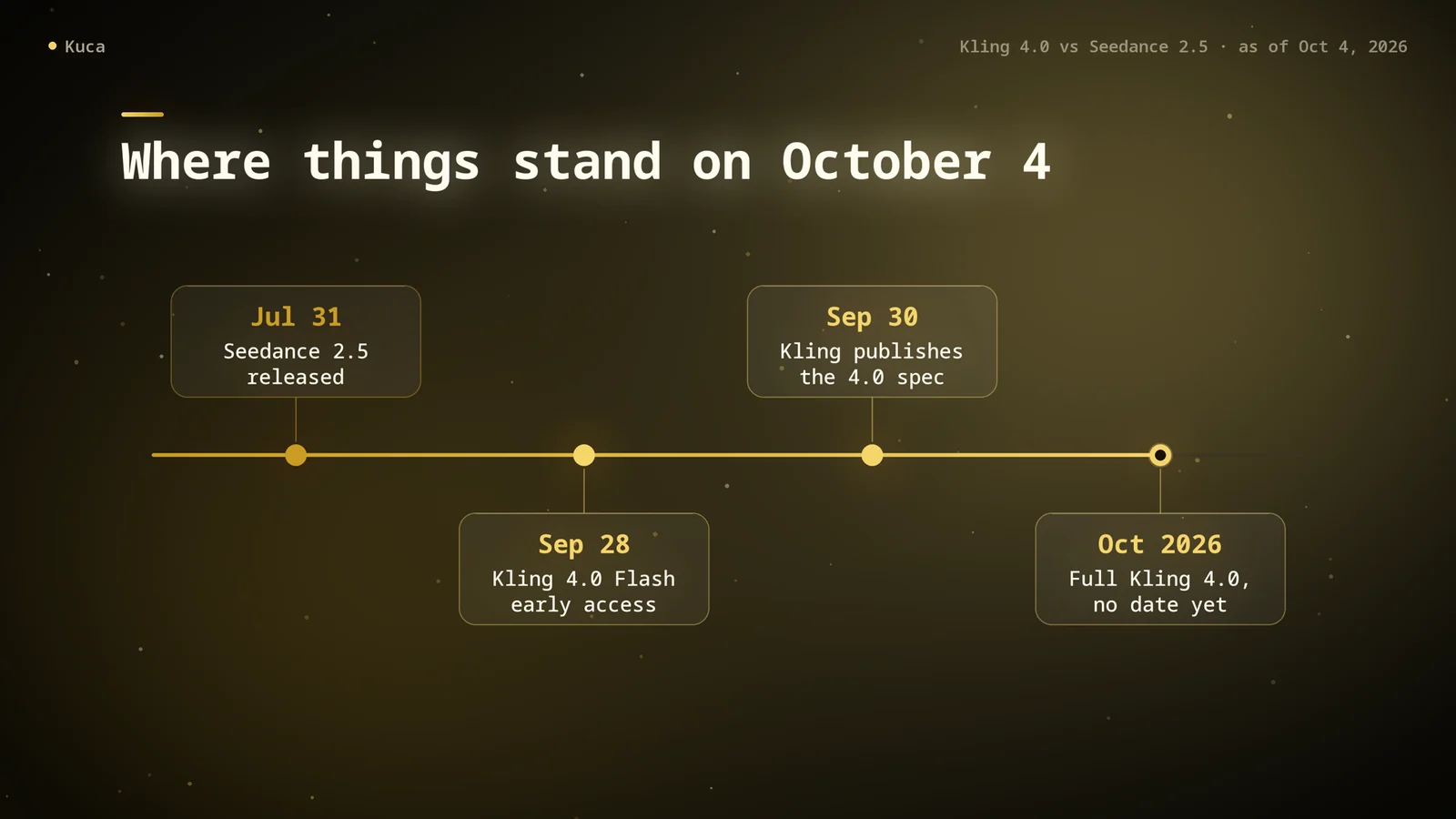
Where things stand on October 4, 2026
- July 31: ByteDance Seed releases Seedance 2.5. It rolls out first in ByteDance's Jimeng AI and Doubao Pro apps, with API access through BytePlus ModelArk announced to follow. Third-party platforms, Kuca included, now offer it as well.
- September 28: Kling 4.0 Flash opens to "a limited group of users" for early access.
- September 30: Kling publishes the Kling 4.0 spec in three places: a launch guide, a Kling 4.0 vs 3.0 comparison and a feature page.
- October: Kling says the full Kling 4.0 "will officially launch in October". At the time of writing, there is still no date.
So any "which is better" verdict on Kling 4.0 is a verdict on a spec sheet. That is still useful for planning, as long as you read it that way.
Kling 4.0 vs Seedance 2.5 on paper
| Kling 4.0 (full model) | Seedance 2.5 | |
|---|---|---|
| Status on Oct 4 | Announced for October 2026; Flash in limited early access | Released July 31, 2026 |
| Length per generation | 3–30 seconds | Up to 30 seconds (4–30 on Kuca) |
| Going past 30 seconds | Extension forward or backward, up to 2 minutes total; Kling's FAQ marks it "coming soon" | Multi-round extension to "multi-minute" content in the launch post; the model page says "extend twice" |
| Controlling timing | Up to 10 keyframe images, plus start and end frames | Time ranges written into the prompt; first and last frame on Kuca |
| References per generation | Up to 15 combined: 10 images, 5 videos (30 seconds total), 7 subjects, voice references | Up to 30 images, 10 video clips and 10 audio clips |
| Editing existing video | Targeted edits from text, image and subject references; up to 5 clips (30 seconds total) per task | Timestamp-level edits to audio and video; green-screen, camera-perspective and reference-based editing |
| Resolution | 720p, 1080p, 4K; 10-bit HDR at 1080p and 4K | No ceiling given in the launch post; 480p or 720p on Kuca |
| Aspect ratios | 16:9, 9:16, 1:1, 21:9, Smart | On Kuca: 16:9, 9:16, 4:3, 3:4, 1:1, 21:9, adaptive |
| Sound | Two-channel stereo, improved lip-sync | Audio generated together with the picture |
Sources: Kling's launch guide, 4.0 vs 3.0 comparison and feature page; ByteDance Seed's Seedance 2.5 launch post and model page. Anything marked "on Kuca" comes from the settings on Kuca's own model pages.
The headline numbers line up; the differences that matter are further down the table.
Kling 4.0 Flash is a different product
If your Kling account already has early access, what you are running is Flash, not the full model from the table above. Kling describes Flash as built on Kling 4.0 with "a subset of its capabilities":
- text-to-video, image-to-video and Omni Reference
- up to 20 seconds per generation
- up to 720p, in 8-bit SDR
- no start and end frames, and no multiple keyframes
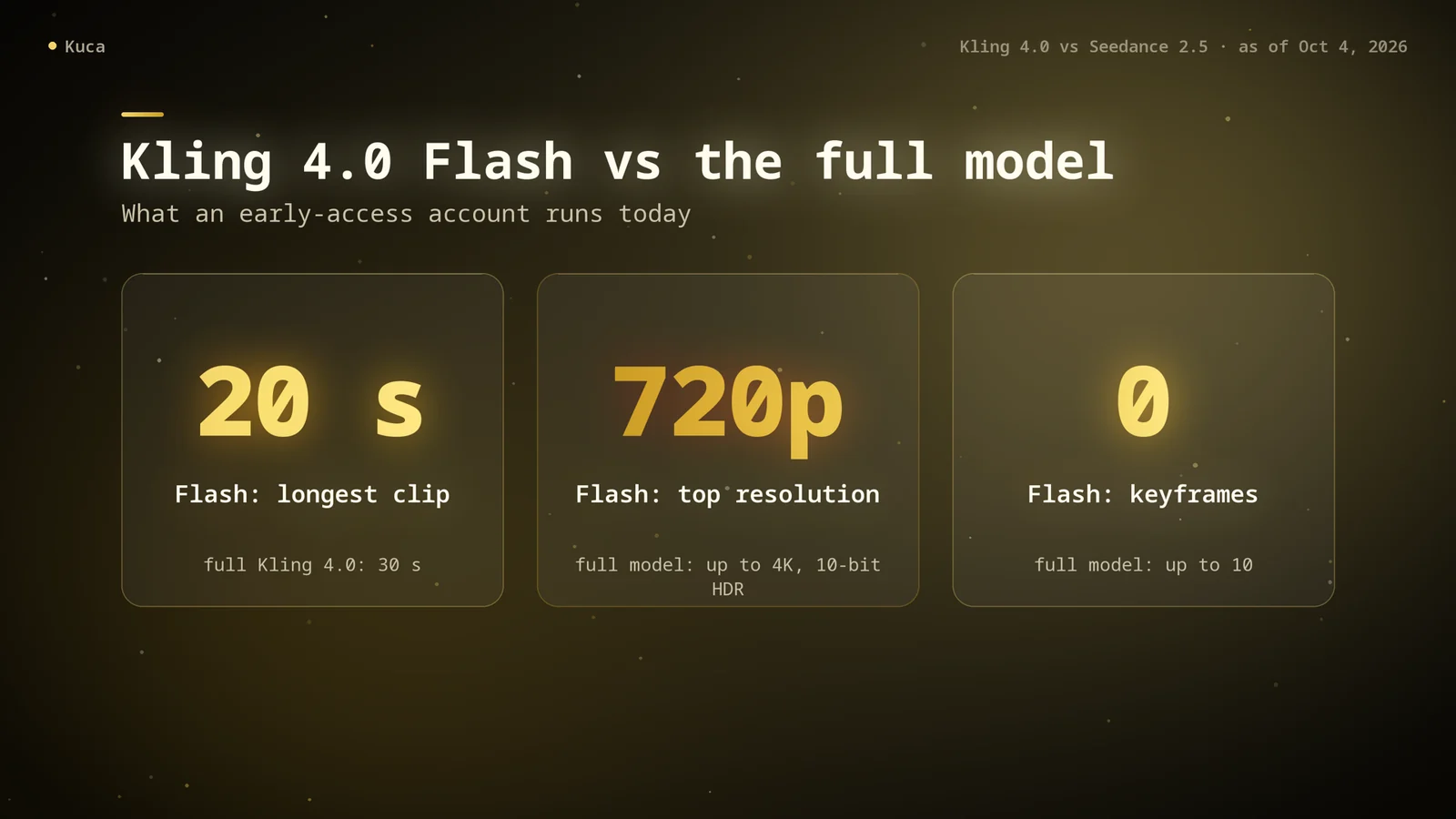
Those gaps are the same features that set the full model apart on paper: keyframe timing, 1080p and 4K, and HDR. A Flash clip shows you how Kling 4.0 handles motion and lighting, but not what the full model can deliver. Put Flash next to Seedance 2.5 at 720p and the resolution is the same, while Seedance still gives you 10 more seconds per clip.
Four differences that should decide it
Timing: keyframes or timestamps
Kling 4.0 lets you pin up to 10 images to points on the timeline. Kling's own example puts a character entrance at 0 seconds, the product at 6, a close-up at 12 and the final campaign shot at 28. You decide what the frame looks like at each beat.
Seedance 2.5 does the same job with words. You write time ranges into the prompt ("0–5s: …, 6–10s: …"), and ByteDance's published examples are written exactly that way. Keyframes win when the exact composition matters, such as a product reveal that has to match an approved shot. Timestamp prompts are faster when what happens matters more than how each frame looks.
References: how many, and what kind
Seedance 2.5 accepts far more material per run. One of ByteDance's examples, a classical concert, uses 18 image references: the hall, the pianist, the lead singer, two instruments, the orchestra, the choir and the audience seating. Kling 4.0 tops out at 15 assets in total, split across images, videos, "subjects" and voice references.
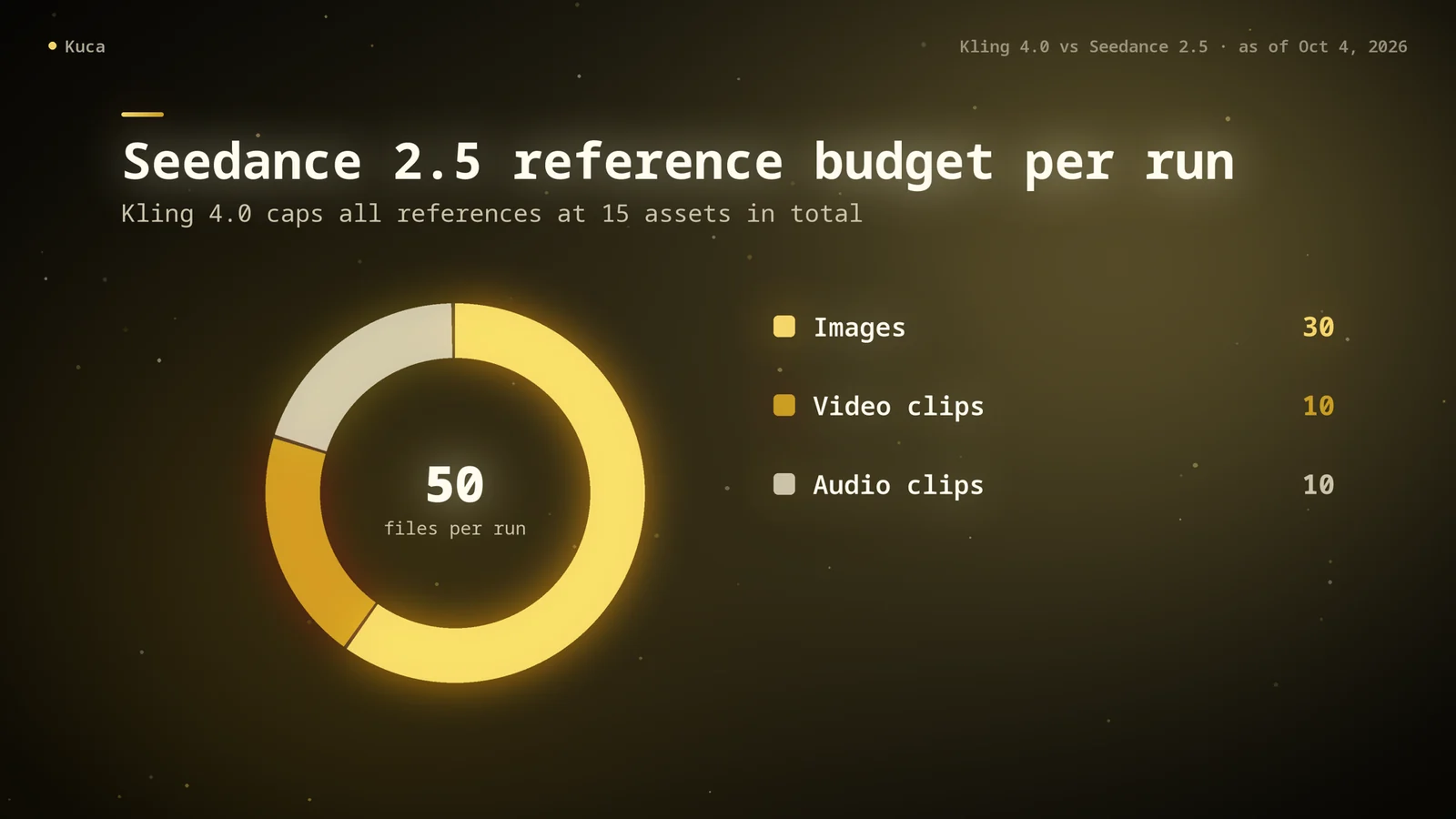
For a large cast or a pile of location and prop images, Seedance's ceiling is a real advantage. With a handful of recurring characters, 15 is plenty and the limit won't come into play. Both models also accept untextured 3D "white model" or clay-render videos to set blocking and camera paths. Kling adds a named Creative Recreation workflow that copies a reference video's pacing and shot structure with your own product or characters swapped in.
Motion: Kling's pitch against Seedance's own admission
Kling's main pitch for 4.0 is stability under pressure: fights, sports, dance, tracking shots and orbits. ByteDance's launch post ends by naming where Seedance 2.5 still has "room for improvement": the physical plausibility of complex motion, and scenes where several subjects interact.
That is one vendor's claim set against the other's self-assessment, not a test result. It does tell you what to test first. If your project is action-heavy, run your hardest shot on both before you commit to either.
Finishing: resolution, HDR and sound
On paper, Kling 4.0 is the one built for delivery: 1080p and 4K, 10-bit HDR, 21:9 and stereo sound. There are two caveats. Kling's launch guide still calls 10-bit HDR "coming soon", while the comparison page and the feature page list it as a spec. And none of it can be used until the full model ships.
ByteDance's launch post gives no resolution ceiling for Seedance 2.5, so what you get depends on where you run it. On Kuca, that is 480p or 720p. If you need Kling at 1080p or 4K today, that means Kling 3.0, which tops out at 15 seconds.
Dialogue and on-screen text in other languages
Kling says Kling 3.0 speaks Chinese, English, Japanese, Korean and Spanish, and that 4.0 adds Portuguese, German, French, Hindi "and more". It also lists accents and dialects such as Indian English, Cantonese and Sichuanese. The feature page says dialogue works "across 9 languages, accents, and dialects". Kling lists the same languages for on-screen text, logos and emoji.
Text drawn in the frame and speech on the soundtrack are separate features, so check the one you actually need.
ByteDance's Seedance 2.5 post does not list dialogue languages at all. What it does claim is that the model can keep both the appearance and the voice of several characters stable in group scenes. If your videos carry dialogue in a language neither vendor names, Dutch or Arabic for example, generate one short test clip before you plan a series around it.
What each costs on Kuca, and where else to run them
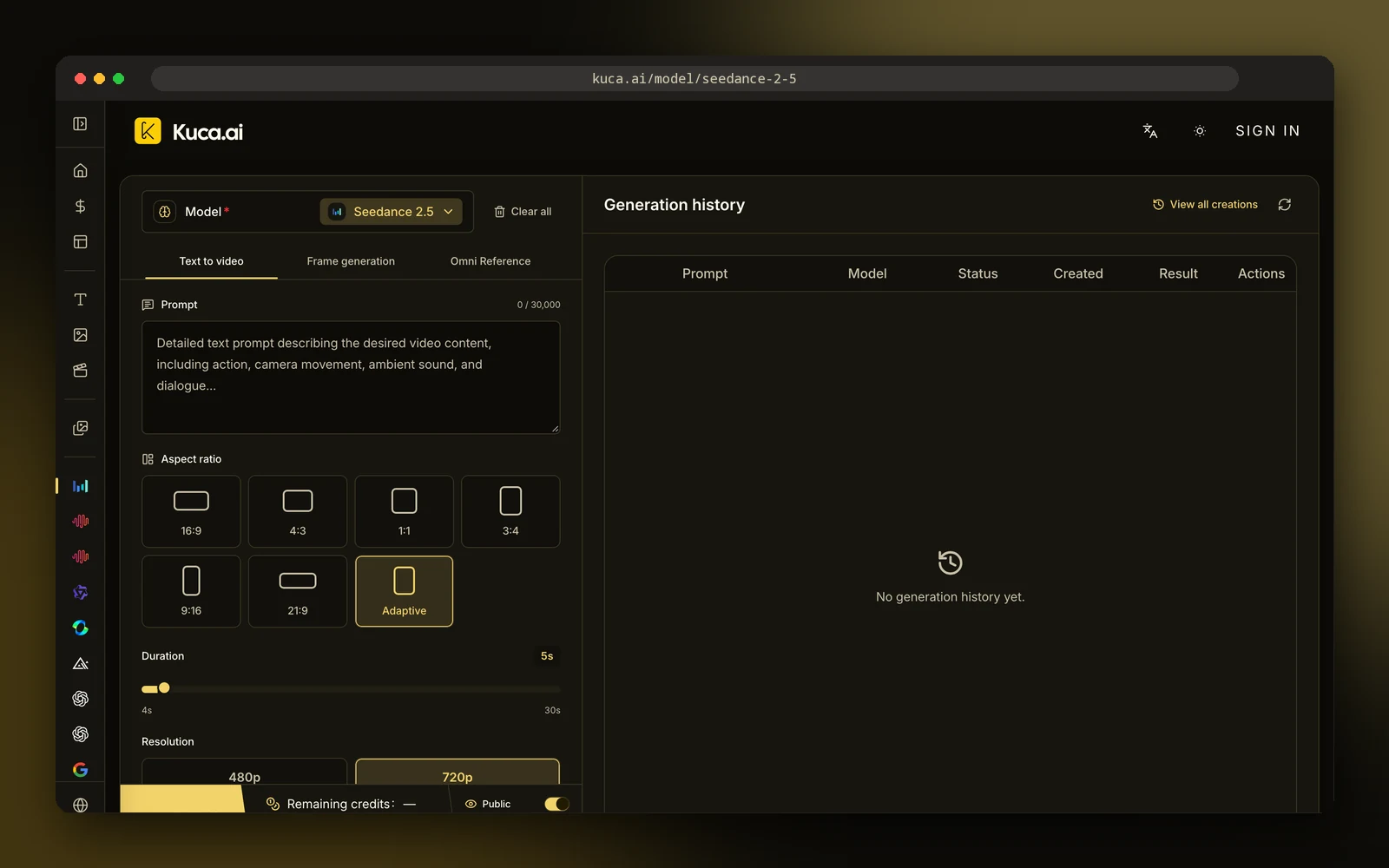
Kuca does not offer Kling 4.0 yet. It does run Seedance 2.5 and Kling 3.0, the current Kling generation. Credit costs on Kuca as of October 4, 2026:
| Model on Kuca | Setting | 5 seconds | 10 seconds | Longest clip |
|---|---|---|---|---|
| Seedance 2.5 | 480p | 112 | 224 | 672 (30 s) |
| Seedance 2.5 | 720p | 252 | 504 | 1,512 (30 s) |
| Kling 3.0 | 720p, without / with audio | 56 / 80 | 112 / 160 | 168 / 240 (15 s) |
| Kling 3.0 | 1080p, without / with audio | 72 / 108 | 144 / 216 | 216 / 324 (15 s) |
| Kling 3.0 | 4K | 268 | 536 | 804 (15 s) |
Two details that change the math:
- Seedance 2.5 costs the same on Kuca with or without generated audio.
- Reference videos are billed on Kuca. Their length is added to the output length at a lower per-second rate. A 10-second 720p Seedance clip costs 504 credits on its own, or 608 with a 10-second reference video attached.
Monthly and yearly plans are on the pricing page. The Starter monthly plan includes 800 credits, which is about three 5-second Seedance 2.5 clips at 720p.
Outside Kuca, Seedance 2.5 runs in ByteDance's own Jimeng AI and Doubao Pro apps. Kling 4.0 Flash is offered through Kling's Creator Studio to accounts with early access, and Kling's advice is to sign in and check.
Which one to pick
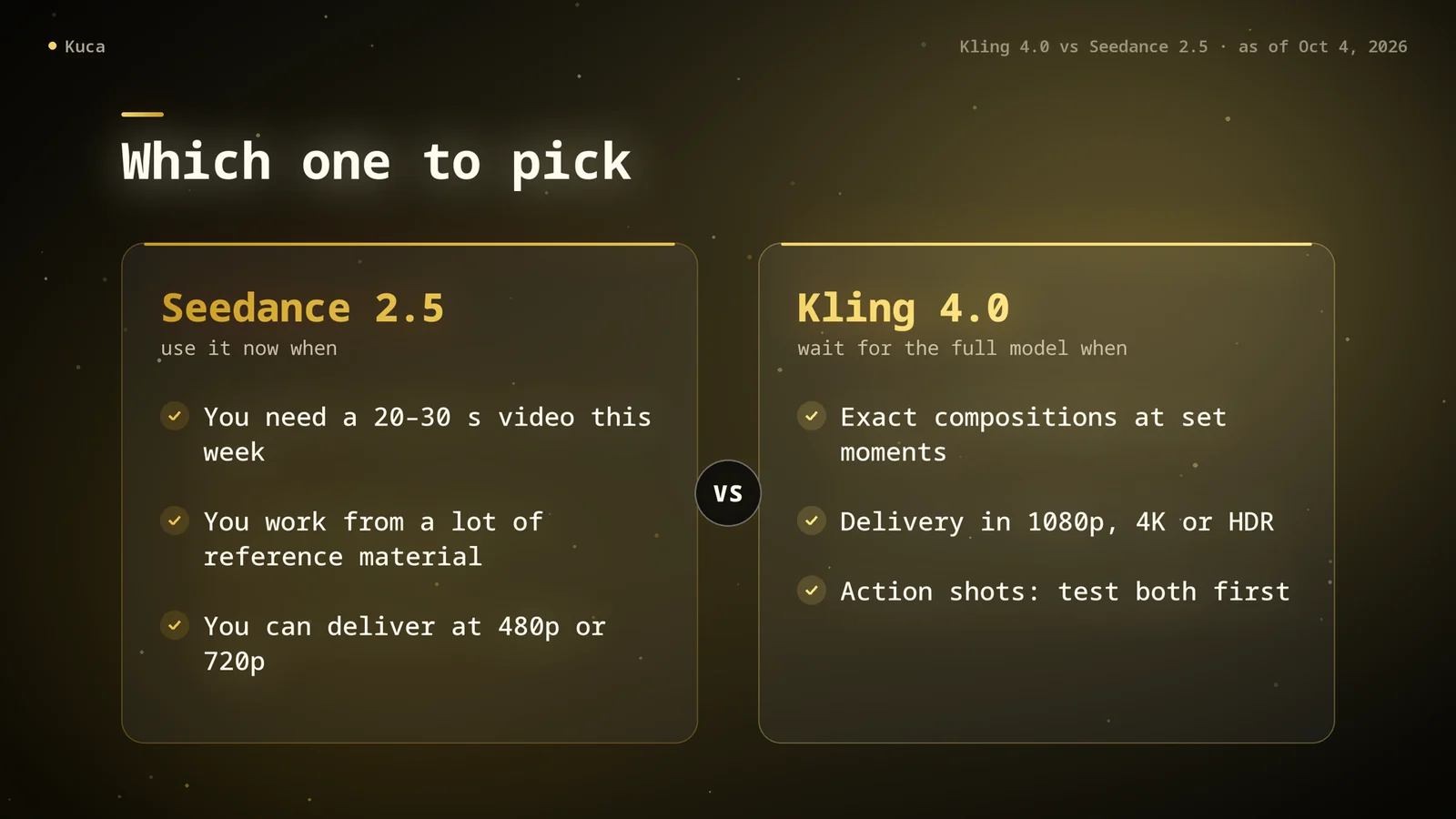
- You need a finished 20–30 second video this week: Seedance 2.5. Of the two, it is the only one you can run at full spec today.
- You're working from a lot of reference material (a cast, several locations, a sound bed): Seedance 2.5. Its 30 / 10 / 10 limits are well above Kling's 15-asset total.
- The deliverable has to be 1080p or 4K now: neither model in the title. Use Kling 3.0 on Kuca and plan shots of 15 seconds or less.
- The video depends on exact compositions at set moments: wait for the full Kling 4.0's keyframes. Until then, build it from shorter clips with first and last frames.
- Action, sport or dance with fast camera moves: test both. Kling is pitching exactly this, and ByteDance names it as an open issue for Seedance.
- You have Kling 4.0 Flash access: use it to judge Kling's look and motion, not 4K, HDR or the keyframe workflow.
The main trade-off right now is a model you can use today against a stronger spec sheet that is not publicly available yet. If you have to choose between Kling 4.0 and Seedance 2.5 this month, start real work on Seedance 2.5, and keep one hard action shot ready to rerun on Kling 4.0 the week the full model ships.
FAQ
Is Kling 4.0 out yet?
Not the full model. As of October 4, 2026, Kling says the full Kling 4.0 will launch in October but has not given a date. Kling 4.0 Flash has been in limited early access since September 28.
Can I use Kling 4.0 on Kuca?
Not yet. Kuca currently offers Kling 3.0 (3–15 seconds, 720p, 1080p or 4K, optional audio) and Seedance 2.5 (4–30 seconds, 480p or 720p).
Does Seedance 2.5 support 1080p or 4K?
ByteDance's launch post does not give a resolution ceiling, and resolution options vary between platforms. On Kuca, Seedance 2.5 renders at 480p or 720p. For higher-resolution output on Kuca today, use Kling 3.0.
Can either model make videos longer than 30 seconds?
Both say yes, with caveats. Seedance 2.5's launch post describes multi-round extension that can reach several minutes, while its model page says you can extend twice. Kling lists extension forward or backward up to 2 minutes in total, but its own FAQ still marks that feature "coming soon". Kuca's Seedance 2.5 page has no separate extend button.